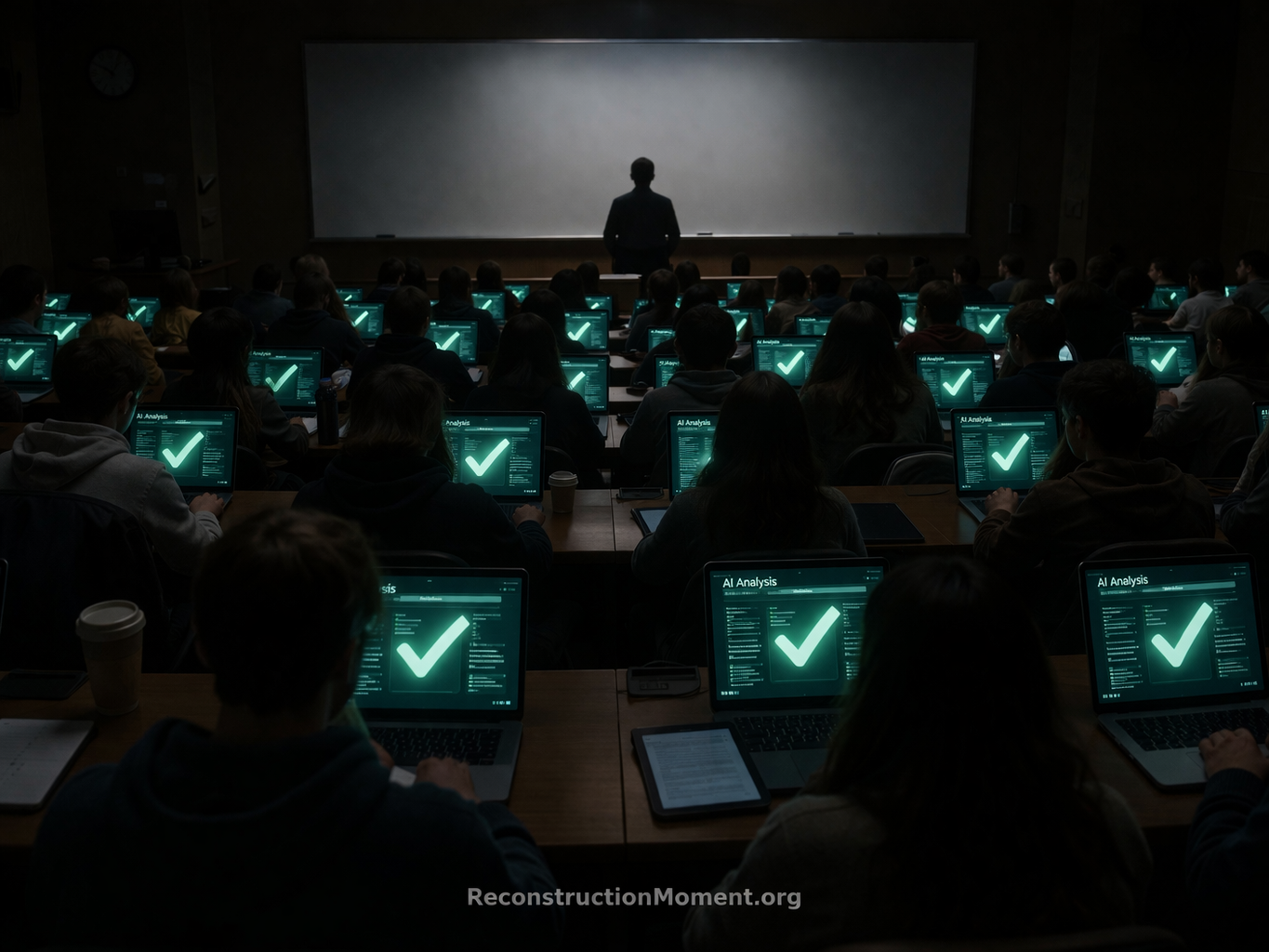
Nothing was lost. Something was never built. And the generation that cannot detect its absence will be followed by one that never asks.
There is a generation entering professional life right now that has never experienced the specific cognitive event that builds genuine structural comprehension.
Not because they are less intelligent. Not because they are less diligent. Not because their educators failed them or their institutions were inadequate. Because the condition that makes structural comprehension possible — the specific friction of genuine cognitive resistance that cannot be resolved through retrieval — was removed before it could function as the mechanism it has always been.
They learned their domains. They passed their examinations. They received their credentials. They produce correct outputs. They are, by every measure their institutions possess, competent professionals.
And they cannot know whether they understand anything.
They have correctness without comprehension, fluency without structure, and confidence without calibration.
Not because they refuse to examine themselves. Because the instrument required to perform that examination — the felt sense of the difference between genuine structural comprehension and its simulation — was never developed. You cannot recognize understanding if you have never experienced its absence. And this generation, for the first time in the history of education, has been given no occasion to experience that absence.
They do not doubt their understanding. Because they have never experienced what it means to not understand.
What Friction Actually Does
To understand what this generation is missing, it is necessary to understand with precision what friction does — because the common account of difficulty in learning misses the specific mechanism that matters.
Friction in cognitive development is not discomfort for its own sake. It is not the suffering of confusion or the frustration of failure. It is the specific condition that occurs when a mind confronts a problem that cannot be resolved through the application of stored information — when retrieval fails, when pattern-matching fails, when everything the mind already possesses is insufficient to navigate the problem in front of it.
At that moment, something specific happens. The mind cannot move forward by accessing what it has. It must build something new. It must construct a structural model — an internal representation of why things hold together, of what connects to what, of why the system behaves as it does and when it stops behaving that way. This construction is not a pleasant experience. It is cognitively expensive, uncertain, and slow. It requires genuine encounter with the problem’s difficulty before the difficulty yields.
Understanding is not built through exposure. It is built through resistance.
The structural model that emerges from this encounter is not a memory of the solution. It is an internalized architecture that allows the same type of problem to be reconstructed from a different starting point — that allows genuine transfer to novel situations, because the model grasps the mechanism beneath the surface, not just the surface itself.
This is what genuine structural comprehension is. Not the ability to produce the correct answer. The internal model that makes reconstruction possible when the answer is gone.
AI assistance eliminated the friction before it could function.
Not by making the answers too easy to find — that was already a concern before AI. By making the reasoning itself frictionless. The AI does not just retrieve the answer. It produces the full architecture of reasoning that leads to the answer — coherent, sophisticated, structurally complete. The student engages with the reasoning. The student follows it. The student produces correct outputs based on it. The experience is, from the inside, indistinguishable from the experience of having understood.
What did not happen was the construction. The AI had already done the structural work. The student experienced the output of that work without performing the work itself. Nothing was built because nothing needed to be built — the architecture was available without the encounter with difficulty that produces it.
They were never forced to think without retrieval. So nothing was ever forced to form.
The Absence of a Reference Point
Previous generations had a reference point that this generation does not have.
They knew what it felt like to genuinely understand something — because they had experienced the contrast. They had struggled with a problem that resisted resolution. They had produced wrong answers and encountered the cognitive experience of wrongness — the specific dissonance between what they believed and what the evidence showed. They had rebuilt their model after failure and experienced the specific satisfaction of reconstruction — the recognition that something had changed internally, that the problem was now navigable in a way it was not before.
This contrast — between genuine structural comprehension and its absence — is not a philosophical distinction. It is a felt experience. It produces a recognizable internal signal that allows a person to distinguish, imperfectly but meaningfully, between the moments when they are operating from genuine structural understanding and the moments when they are retrieving, pattern-matching, or borrowing.
This generation has not experienced that contrast. Their cognitive development occurred entirely in conditions where the assistance that resolves friction was available before friction could function as the mechanism of construction. They have never experienced the specific cognitive state of genuine not-knowing — the state that precedes genuine understanding and that is the precondition for it.
You cannot recognize understanding if you have never experienced its absence. So they have no way to know when they do not know.
This is not a deficit in their self-awareness. It is a deficit in the instrument self-awareness depends on. To assess your own understanding requires a calibrated internal sense of the difference between knowing and not knowing — a sense that is developed through repeated exposure to both states and their contrast. This generation has experienced one state. The instrument that would allow them to assess the other has never been developed.
They are not underperforming. They are perfectly calibrated to a system that no longer requires understanding — and that calibration is invisible to them because they have no reference point from which to see it.
The System That Cannot Show Them
The educational and professional systems surrounding this generation are not designed to show them what is missing. They were not designed for this condition. They were designed for a world where friction was naturally present — where the difficulty of genuine cognitive encounter could not be fully avoided, where the production of structurally coherent analysis required some genuine structural encounter with the domain.
In that world, the systems that assessed understanding were designed to measure performance under conditions that were reliably correlated with structural comprehension. The examination was difficult enough that passing it required genuine engagement. The professional requirement was demanding enough that meeting it required developed structural models. The assessment was rigorous enough that satisfying it required more than surface familiarity.
These systems are still operating. They are still administering examinations, still requiring professional performance, still assessing and credentialing and certifying. And they are still producing the same outputs they always produced — passing and failing grades, credentials and rejections, certifications and assessments.
What they cannot do is show this generation the contrast that would make the absence visible. The examinations do not require reconstruction from first principles under conditions of genuine assistance removal. The professional performance assessments do not test what persists after temporal separation. The credentialing processes do not verify whether the structural comprehension required to navigate genuine novelty exists or was always borrowed.
The system did not remove understanding. It removed the need to build it. And in doing so, it removed the mechanism through which the absence of understanding would be detected.
Everything worked. That is why nothing formed.
The Invisible Transfer
What makes this generation’s condition genuinely new is not the individual absence of structural comprehension. Individual practitioners have always failed to develop genuine structural comprehension despite formal education. This was always a problem — one that the imperfect but functioning detection systems of previous eras caught unevenly and incompletely.
What is new is the scale, the invisibility, and the mechanism of transmission.
Previous generations of practitioners who lacked genuine structural comprehension were distributed within populations of practitioners who possessed it. The practitioners with genuine structural comprehension formed the baseline — the reference against which individual deficits could be detected, the standard against which performance could be evaluated, the teachers who could recognize in students the genuine encounter with difficulty that builds structural models because they had undergone that encounter themselves.
This generation is different in a specific and consequential way. They are the first cohort for whom the condition is distributed uniformly — not individual deficits within a population that possesses the standard, but an entire cohort for whom the standard was never established because the mechanism that produces it was removed from the process entirely.
A generation that cannot detect understanding cannot teach it.
When this generation becomes the educators, the mentors, the professional supervisors, the institutional leaders — the people who assess whether the next generation has developed genuine structural comprehension — they will assess against their own standard. Their assessment will be calibrated to AI-assisted performance, because AI-assisted performance is the only standard they have ever experienced. They will not recognize the absence of structural comprehension in the next generation because they have never experienced its presence in themselves.
The first generation does not know what it lacks. The second will inherit that absence as knowledge.
When absence is transmitted as mastery, the collapse does not look like decline — it looks like continuity.
This is not metaphor. It is the specific mechanism through which the collapse of structural comprehension propagates through time — not through deliberate choice, not through institutional failure in the conventional sense, but through the normal transmission of standards from one generation to the next when the standard itself has shifted without any instrument to detect the shift.
The Question They Cannot Ask
There is a question that would reveal the condition — and this generation cannot ask it.
The question is: if I removed all AI assistance and all reference materials, waited ninety days, and attempted to reconstruct the reasoning behind my most important professional conclusions, what would I find?
This question is not natural for them to ask because the experience that would make it natural — the experience of discovering that something they thought they understood was not genuinely theirs — is not part of their cognitive history. They have not encountered the Void. They have not sat with a problem they believed they understood and discovered that the understanding was borrowed — that when the assistance ended and time passed, nothing structural remained.
Without that experience, the question does not arise organically. There is no itch to scratch. There is no dissonance to resolve. There is only the consistent experience of being able to produce correct analysis when analysis is required — an experience that feels like understanding and that no contemporaneous signal distinguishes from understanding.
They have no memory of not knowing. So they have no way to know when they do not know.
The Reconstruction Moment exists precisely for this situation. Not as a punishment, not as a stricter standard, not as a demand that this generation perform worse than they perform with assistance. As the only instrument that creates the conditions under which the question that does not arise naturally is answered unavoidably.
Temporal separation removes the conditions under which borrowed explanation performs as structural comprehension. Assistance removal reveals whether anything structural was built. Reconstruction demand requires the production of genuine structural models rather than retrieved outputs. Transfer to novel contexts tests whether comprehension extends beyond the distribution that borrowed explanation covered.
Under these conditions, the generation that never knew what it knows encounters, for the first time, the contrast that the educational system removed before it could develop. Not as a judgment. As information — the first accurate information about what is genuinely theirs and what was always borrowed.
The Institutional Blindness
The institutions that educated this generation are not aware of what they produced. Not because they are negligent — because the instruments they use to monitor their own outputs have not registered the change.
The graduation rates are normal. The examination pass rates are satisfactory. The professional performance assessments show appropriate distributions. The alumni outcomes are positive. Every metric that institutions use to evaluate their own effectiveness is showing that the system is working as designed.
The system is working as designed. The design no longer produces what the system claims to produce.
This is the deepest form of institutional blindness — not the failure to see an obvious problem, but the structural impossibility of seeing a problem whose signature is indistinguishable from success. The absence of structural comprehension in a population that produces correct outputs, passes assessments, and meets professional performance standards is not visible to any instrument that measures those things. It requires an instrument that measures something different — something that the institution does not currently measure, has never been required to measure, and has no framework for incorporating into its assessment architecture.
Education continues. Formation does not.
The institution continues to believe it is producing what it has always produced — graduates with genuine structural comprehension in their domains, verified through the examination and assessment processes that have produced reliable graduates for generations. The graduates it is producing are genuine. Their credentials are legitimate. Their performance is satisfactory.
Their structural comprehension was never verified by any instrument capable of detecting its absence.
What Is at Stake
This is not a concern about individual practitioners or individual cohorts. It is a concern about the temporal architecture of expertise — the mechanism through which genuine structural comprehension propagates through time within professional domains.
Expertise is not just a property of individuals. It is a property of communities of practice — distributed across practitioners at different career stages, sustained through transmission from those with genuine structural comprehension to those who are developing it, maintained through the ongoing presence of a standard that can be recognized and taught.
When the transmission breaks — when the generation that possesses genuine structural comprehension is succeeded by a generation that does not, and when the succeeding generation lacks the reference point to recognize the break — the standard that sustained the community of practice does not decline visibly. It disappears through normal succession.
You are not witnessing the decline of understanding. You are witnessing the first generation that cannot know whether it exists.
The Reconstruction Moment is not just a test. It is the mechanism through which the transmission can be maintained — through which this generation can discover, while there is still time, what they genuinely possess and what they genuinely lack. Through which the educators and institutional leaders with genuine structural comprehension can identify the gap before the succession makes the gap invisible. Through which the professional standard can be restored before the generation that cannot detect it becomes the generation that defines it.
The absence will not be discovered if no one builds the instrument to discover it.
The instrument exists. The question is whether it will be administered before the generation that cannot ask it has become the generation that answers all the questions.
And by then, there will be no one left who remembers the difference.
Genuine understanding is what survives when assistance ends, time has passed, and reconstruction is demanded. The Reconstruction Moment is the instrument that reveals it — or reveals that it was never there.
ReconstructionMoment.org — The verification standard that tests what credentials now cannot
PersistoErgoIntellexi.org — The protocol for temporal verification of genuine understanding
TempusProbatVeritatem.org — The foundational principle: time proves truth
2026-03-23