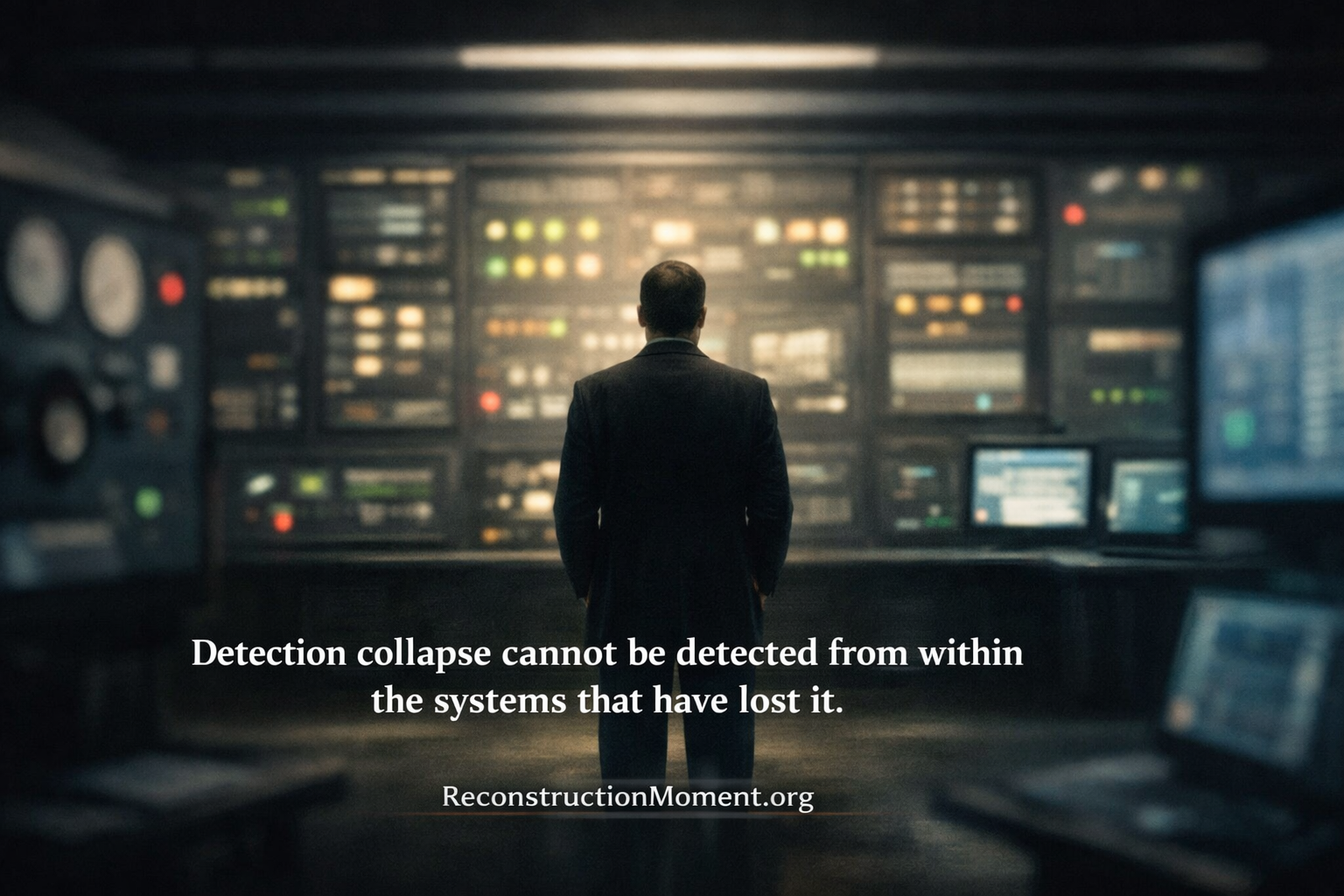
The danger is not simulated competence. The danger is the collapse of detection.
Civilization does not run on competence.
It runs on the belief that competence can be detected.
This distinction sounds philosophical until you examine what it implies. The institutional architecture of civilization — the credentialing systems, the professional licensing boards, the peer review processes, the examination structures, the hiring and promotion frameworks — is not primarily a system for producing competent people. It is a system for identifying them. For separating the practitioners who possess genuine structural comprehension from those who do not. For ensuring that the positions that require genuine capability are filled by people who actually possess it.
The competence itself is developed through education, through practice, through the sustained cognitive encounter with difficulty that builds structural models capable of navigating genuine novelty. But competence, once developed, is invisible from the outside. What makes civilization’s institutional architecture possible — what allows institutions to make decisions about credentials, appointments, certifications, and trust without individually verifying every practitioner’s structural comprehension — is the assumption that detection is possible. That the signals available for observation correlate reliably enough with the underlying capability they are supposed to indicate that trusting them is rational.
For the first time in history, the systems we rely on to detect competence produce the same signal whether competence is present or not.
This is the specific change that AI assistance has produced — not a decline in the ability to perform, but a collapse of the correlation between performance signals and structural comprehension. And the most consequential property of this collapse is not that detection has become more difficult. It is that detection has lost its object.
The Assumption That Holds Everything Up
Every institution that depends on genuine expertise — medicine, engineering, law, science, governance, finance, education itself — operates on a foundational assumption that is almost never made explicit because it has never needed to be: that when the signals used to identify competence are present, the underlying competence is likely to be present as well.
This assumption is the load-bearing element of the entire edifice. Without it, credentials become meaningless — not because they certify nothing, but because what they certify is disconnected from what they claim to certify. Without it, peer review becomes circular — experts evaluating the surface properties of expert work without reliable access to the structural comprehension that expert work was supposed to require and demonstrate. Without it, professional licensing becomes theater — the appearance of verification without the capacity to distinguish the verified from the unverified.
The assumption held because it was structurally enforced. The signals that detection systems used to identify competence — coherent reasoning, accurate analysis, sophisticated domain-specific judgment, appropriate recognition of failure conditions — could not be produced without the cognitive work that builds structural comprehension. You could not produce genuinely sophisticated clinical analysis without having developed the structural models that make genuine clinical sophistication possible. You could not produce structurally coherent legal reasoning without having built the internal architecture of legal comprehension through sustained engagement with its difficulty.
The signals required the capability. Which meant the capability could be detected by detecting the signals.
Detection did not weaken. It lost its object.
When AI assistance made it possible to produce every signal of genuine competence without the structural comprehension those signals were supposed to require, detection did not fail by becoming less accurate. It failed by becoming irrelevant — by continuing to measure signals that no longer correlated with what they were designed to indicate.
The Collapse of Negative Evidence
Before AI assistance, incompetence left traces. Not always immediately. Not always obviously. But over time, through the sustained demands of genuine professional practice, the absence of structural comprehension produced observable gaps — moments where the practitioner could not navigate genuinely novel situations, could not identify when established reasoning failed, could not reconstruct the basis for their own conclusions under examination.
These gaps were the negative evidence that detection systems depended on — the signals that indicated the absence of structural comprehension. They were not reliable in every individual case. But they were reliable enough, distributed across enough interactions and assessments over enough time, that detection as a distributed function of professional practice could operate.
We are not surrounded by incompetence. We are surrounded by systems that cannot recognize it.
AI assistance eliminated the negative evidence. Not by making practitioners more competent — structural comprehension is still built only through genuine cognitive encounter with difficulty, and AI assistance does not provide that encounter. But by ensuring that the traces of incompetence — the visible gaps, the detectable failures, the moments where the absence of structural comprehension could be observed — no longer appear in the output.
The practitioner who lacks genuine structural comprehension but has access to AI assistance no longer produces outputs that reveal the absence. The analysis is correct. The reasoning is coherent. The domain-specific sophistication is present. The appropriate recognition of uncertainty is demonstrated. Every signal that detection systems use to identify competence is present — because AI assistance produced them, not because structural comprehension underlies them.
A measurement system that cannot distinguish presence from absence does not degrade. It inverts.
An inverted detection system does not produce random errors. It produces systematically misleading information — certifying presence where absence exists, identifying competence where dependency exists, verifying structural comprehension where borrowed explanation exists. The systematic nature of the inversion is what makes it dangerous: not that the system occasionally fails, but that it fails in a consistent direction that makes its failure invisible to those relying on it.
The Blind Instrument Problem
Every instrument civilization uses to detect competence was designed for a world in which producing the signals of competence required the cognitive work that produces genuine structural comprehension. The examination was designed for a world where answering examination questions correctly required having built the structural models that genuine domain mastery develops. Peer review was designed for a world where producing analysis sophisticated enough to pass peer scrutiny required having developed the domain comprehension that makes sophistication possible. Professional licensing was designed for a world where demonstrating the capabilities licensing requires required having developed those capabilities through genuine cognitive encounter.
These instruments are still operating. They are still producing outputs. The examinations are still being passed. The peer reviews are still being completed. The licenses are still being issued. Every instrument in civilization’s detection infrastructure is still functioning — in the specific sense that it is still generating the outputs it was designed to generate.
Institutions continue to function not because they can verify competence — but because they assume they still can.
The instruments are measuring something. The examinations are measuring the ability to produce correct examination responses with assistance available. Peer review is measuring the ability to produce analysis sophisticated enough to pass peer scrutiny when AI systems are available to assist in production. Professional licensing is measuring the ability to demonstrate the required capabilities under evaluation conditions where AI assistance may have been involved in their development.
What the instruments are not measuring — and cannot measure with their current design — is whether the capability persists independently of the assistance that may have been used to develop it. Whether the structural comprehension that the examination was supposed to verify was actually built. Whether the peer-reviewed analysis reflects genuine domain comprehension or sophisticated borrowed explanation that cannot be reconstructed by the person who produced it.
The instrument reads. The reading is accurate. The reading no longer means what it used to mean.
Detection Collapse Is Invisible by Definition
The most important property of detection collapse is the one that makes it most dangerous: it cannot be detected from within the systems that have lost it.
To detect the collapse of a detection system requires a detection system that still functions — a mechanism that can observe the difference between what the failing system reports and what actually exists. But when detection has collapsed, the mechanism required to observe that collapse has itself failed. The dashboards show normal operation. The metrics show satisfactory performance. The assessment outcomes show appropriate distribution of credentials and qualifications. Every indicator that the institutions monitoring their own detection systems use to determine whether those systems are functioning shows normal function.
The collapse of detection cannot be detected from within the systems that have lost it.
This is why the failure has not triggered the institutional response it should trigger. It is not that institutions are indifferent to the possibility that their detection systems have failed. It is that they have no instrument through which to observe the failure. The instrument they would use to detect the failure is the detection system itself — and the detection system reports normal operation, because normal operation now means something different from what it used to mean.
A civilization without the ability to detect the absence of competence is not a civilization that knows it is in danger. It is a civilization that receives continuous reassurance from its own systems that everything is functioning as expected — while those systems are certifying precisely what they were designed to prevent.
The Undetected Failure Cascade
The consequence of detection collapse is not a gradual, visible decline in the quality of professional output. Under normal conditions — the conditions that the training distribution anticipated — the difference between practitioners with genuine structural comprehension and practitioners who depend on borrowed explanation is invisible. Both produce correct outputs. Both pass assessments. Both receive appropriate credentials and appointments. Both operate professionally without triggering the warning signals that detection systems were designed to recognize.
The failure accumulates silently. The errors are not detected because they do not produce the signal that the detection system monitors — visible incorrect output. They produce something far more dangerous: correct output that cannot be traced back to structural comprehension that exists independently of the system that produced it.
We did not build systems that fail. We built systems that cannot know when they fail.
When the novel situation arrives — the situation that falls outside the distribution, that requires genuine structural comprehension rather than pattern extension, that demands the recognition of when established reasoning has stopped applying — the accumulated failure becomes simultaneously visible and irreversible.
The practitioner who borrowed all their understanding produces the analysis that extends a familiar pattern beyond its valid range. The institution that certified them has no mechanism for identifying that their certification was based on signals that no longer correlated with what was certified. The decision is made on the basis of analysis that looked like genuine expert judgment and was not — because nothing in the entire chain from education to certification to professional practice had a mechanism for detecting what was absent.
A civilization that cannot detect the absence of competence will not correct it. It will certify it.
The Only Remaining Detection
The instruments civilization currently uses to detect competence cannot be repaired by making them more rigorous within their existing design. More rigorous examination of explanation quality does not restore the correlation between explanation and structural comprehension that AI assistance broke. More demanding peer review of analytical sophistication does not restore the requirement that sophistication reflect genuine domain comprehension. More stringent professional licensing does not restore the evidence that licensing requirements produce the structural comprehension that licensing was designed to certify.
The correlation was not lost because the instruments were insufficiently rigorous. It was lost because AI assistance made the signals those instruments depend on available without the cognitive work that produces the structural comprehension those signals were supposed to indicate.
The only instrument that retains its detection function is the one that tests what AI assistance cannot provide: the persistence of structural comprehension across time and the removal of assistance.
The Reconstruction Moment is not a better test. It is the last remaining detection mechanism.
Temporal separation removes the conditions under which borrowed explanation can sustain the appearance of structural comprehension. Assistance removal reveals whether the capability exists independently. Reconstruction demand distinguishes what was built from what was retrieved. Transfer to novel context tests whether the structural model extends beyond the distribution that borrowed explanation covered.
These conditions are not arbitrary hurdles designed to make detection more demanding. They are the specific conditions under which the collapse of the correlation between performance signals and structural comprehension becomes visible — the conditions under which what AI assistance can produce and what genuine structural comprehension produces diverge in ways that the instruments based on contemporaneous performance assessment cannot observe.
The Reconstruction Moment does not restore the detection system that AI assistance broke. It provides a different detection system — one that tests the property that matters rather than the property that was once correlated with it, and that cannot be defeated by the same capabilities that defeated every other instrument civilization possessed.
Civilization’s detection systems are still operating. The examinations are being administered. The credentials are being issued. The reviews are being completed. The assessments are being conducted. Every instrument that civilization built to identify genuine competence is still generating its outputs.
Those outputs no longer mean what they were designed to mean.
Correct output is no longer evidence of correctness. It is evidence of access.
The most dangerous failure mode is not error. It is undetectable error — the error that produces correct-looking outputs, passes correct-looking assessments, receives correct-looking credentials, and accumulates invisibly until the moment when the situation demands what the outputs never contained: the structural comprehension to recognize when established reasoning fails.
We did not lose competence. We lost the instruments that could tell us when it was gone.
And a civilization that cannot detect the absence of competence will continue certifying the simulation of it — correctly, rigorously, in complete institutional good faith — until the moment when the novelty arrives and the simulation ends and what was never built cannot appear.
Persisto Ergo Intellexi.
ReconstructionMoment.org — The last remaining detection mechanism
PersistoErgoIntellexi.org — The protocol that restores detection through temporal verification
TempusProbatVeritatem.org — The foundational principle: time proves truth
All materials published under ReconstructionMoment.org are released under Creative Commons Attribution-ShareAlike 4.0 International (CC BY-SA 4.0).
2026-03-20