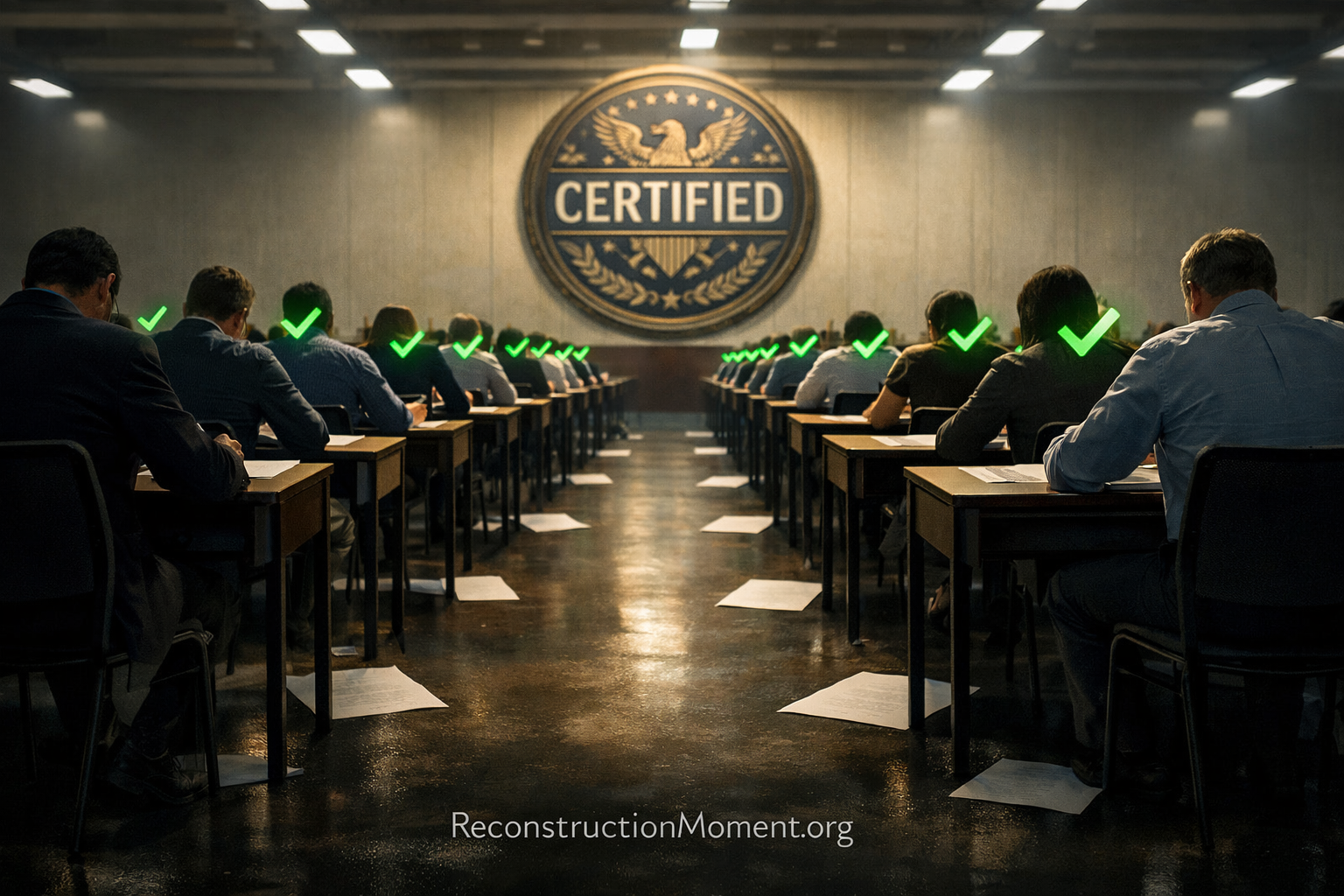
The Reconstruction Requirement
If it cannot be reconstructed without assistance, it was never understood. This is not a stricter standard. It is the only standard that still measures what it claims to measure.
There is a logical consequence of AI assistance that no institution has yet drawn.
It is not complex. It does not require new research, new frameworks, or new theoretical apparatus. It follows directly from what AI assistance is and what it does — from the specific property of AI systems that makes them useful and the specific property that makes every existing verification system structurally invalid.
The consequence is this:
If AI can produce every signal of genuine understanding without understanding existing, then every verification process that tests contemporaneous performance is no longer a verification of understanding. It is a verification of access.
This is not a gradual degradation of verification quality. It is not a situation where existing verification systems are somewhat less reliable than they used to be. It is a structural invalidation — the specific condition in which the signals that a measurement system depends on have been decoupled from the property the system was designed to measure, making the measurement systematically misleading rather than merely imprecise.
You do not have a verification system. You have a system that produces the appearance of verification.
Every certification that does not include reconstruction is not weaker. It is false. And you are already relying on people whose understanding has never been verified.
The logical consequence of this is not optional. When a measurement system no longer measures what it claims to measure, the choices are to fix the measurement system or to continue operating on the basis of measurements that are systematically misleading. There is no third option that involves continuing to use the current system while acknowledging its failure — because the failure is structural, not incidental, and acknowledging it while continuing to rely on its outputs is not a pragmatic accommodation. It is a decision to operate on false information.
The Reconstruction Requirement is not a proposal. It is the logical consequence of a fact.
What Reconstruction Tests That Nothing Else Can
To understand why reconstruction is the only remaining verification that works, it is necessary to understand precisely why everything else has stopped working — and why the failure is complete rather than partial.
Every existing verification system that education and professional credentialing currently uses depends on contemporaneous performance assessment: the evaluation of outputs produced in the moment of assessment, by a practitioner who has access to whatever resources and assistance they would normally use in their professional practice.
This was a reasonable design for the conditions under which it was developed. Before AI assistance was ubiquitous, contemporaneous performance was reliably correlated with structural comprehension. The assessment that asked for sophisticated analysis was reliable evidence of genuine analytical capacity because producing sophisticated analysis required the cognitive work that builds analytical capacity. The examination that tested complex reasoning was reliable evidence of genuine reasoning capacity because passing it required the sustained intellectual encounter with difficulty that produces structural reasoning models.
The correlation held because it was structural — because the signals that assessment systems measured could not be produced without the capability those signals were supposed to indicate.
AI assistance broke the correlation completely. Not partially, not in edge cases, not for some types of assessment but not others. Every signal that contemporaneous performance assessment depends on — coherent reasoning, accurate analysis, sophisticated domain-specific judgment, appropriate uncertainty, structurally complete explanation — can now be produced without the structural comprehension those signals were supposed to require.
Every assessment that tests what can be produced in the moment with assistance available has ceased to be a test of structural comprehension. It has become a test of what the practitioner can access.
Reconstruction tests something that access cannot provide.
The structural model that genuine comprehension builds — the internal architecture that makes reasoning reconstructible from different starting points, that makes knowledge transferable to genuinely novel situations, that makes failure conditions identifiable even when they have not been previously encountered — is not available through access. It is built through genuine cognitive encounter with difficulty, and it exists only inside the mind that performed that encounter.
AI assistance can produce the appearance of this architecture. It cannot produce the architecture itself. When assistance ends and time has passed and reconstruction is demanded, the architecture is either present — because it was built through genuine cognitive encounter — or it is not. There is no intermediate state. There is no version of this test that access can defeat.
Reconstruction is not a better test. It is the only test that remains.
The Three Properties That Make It Unchallengeable
The Reconstruction Requirement rests on three properties that together make it the only verification standard whose validity AI assistance cannot compromise.
The first property is temporal separation. Reconstruction must occur after a minimum interval — ninety days at standard verification, one hundred and eighty days at high-assurance verification — between the original acquisition of the material and the reconstruction attempt.
Temporal separation is not an arbitrary delay. It is the mechanism that removes the confounders that allow borrowed explanation to perform as structural comprehension in the immediate aftermath of acquisition. Short-term memory, residual contextual familiarity, and pattern recall from recent exposure can sustain the appearance of structural comprehension for days or weeks without any genuine structure being present. Ninety days removes these confounders with sufficient reliability to make the distinction between structural comprehension and borrowed explanation visible.
What has not survived ninety days of temporal separation cannot be claimed as genuine structural comprehension. What has survived is the structural residue that genuine cognitive encounter produces — the internal architecture that persists independently of the specific formulation in which the material was originally encountered.
The second property is complete assistance removal. During reconstruction, no external support is available. No AI systems, no notes, no prior outputs, no reference materials, no retrieval cues of any kind. The practitioner stands alone with the problem and what exists internally.
This condition is not a difficulty parameter. It is the definition of what the test is measuring. The Reconstruction Requirement tests whether structural comprehension exists independently — whether the internal model is present and generative. If any external system is available during reconstruction, the test has not been administered. What is being observed is the combined performance of the practitioner and the system, which does not reveal whether the practitioner’s independent structural comprehension exists.
Assistance removal is not optional. It is the boundary condition that defines whether reconstruction is occurring at all.
The third property is genuine novelty. Reconstruction must occur in a context that differs meaningfully from the original acquisition context — one that requires genuine adaptation of the structural model rather than pattern repetition within the original distribution.
Genuine novelty is required because pattern repetition within a familiar distribution can sustain the appearance of structural comprehension without the structural model being present. A practitioner who has been exposed to a sufficient number of examples of a pattern can reproduce that pattern in familiar territory without having developed the structural model that makes the pattern generative. Only genuinely novel contexts — contexts that fall outside the pattern distribution and require the structural model to adapt rather than repeat — reveal whether the structural model exists or whether what appeared as structural comprehension was sophisticated familiarity with a specific distribution.
These three properties are not configurable. Remove temporal separation and the test measures retention. Remove assistance removal and the test measures augmented performance. Remove genuine novelty and the test measures pattern repetition. In each case, what remains is not a version of reconstruction. It is a different measurement that cannot distinguish structural comprehension from borrowed explanation.
Every system that does not include all three properties is not an incomplete version of reconstruction. It is a different measurement entirely — one that AI assistance can defeat.
Why No Institution Has Administered It
The Reconstruction Requirement is not a new idea. The cognitive reality it formalizes — that genuine structural comprehension can be distinguished from borrowed explanation through temporal separation, independence, and novel reconstruction — has been understood in various forms throughout the history of education and professional training.
The Socratic examination was an informal version of it: remove the ability to retrieve prepared answers and demand derivation from first principles in real time. The traditional doctoral examination required reconstruction and transfer under conditions of genuine intellectual challenge. The apprenticeship model embedded reconstruction naturally through the progressive demands of genuine professional practice.
These approaches worked precisely because they required the practitioner to stand alone with the problem. They were imperfect — not temporally separated enough, not consistently administered, not calibrated against a rigorous specification of what genuine structural comprehension requires. But they were working versions of the correct instrument.
They have been replaced by contemporaneous performance assessment — examinations that test what can be produced in the moment, professional demonstrations that evaluate output quality under assisted conditions, credentials that certify performance in the presence of the assistance that will always be available to the practitioner being certified.
The reasons for this replacement are not mysterious. Contemporaneous performance assessment is faster, cheaper, more scalable, and more defensible than reconstruction testing. It produces results that are easier to explain, compare, and use as the basis for institutional decisions. It is less threatening to practitioners who have invested years in developing their credentials. It generates less discomfort for the institutions that issue those credentials and for the practitioners who hold them.
These are real advantages. They are also the specific properties that make contemporaneous performance assessment structurally unable to verify what it claims to verify in the AI era.
The Reconstruction Requirement is not convenient. It is correct. And the gap between convenient and correct — the gap between the assessment systems that exist and the assessment that would actually verify structural comprehension — is the gap in which an entire generation has developed credentials that do not certify what credentials claim to certify.
Institutions will not adopt the Reconstruction Requirement because it is theoretically preferable. They will adopt it when the cost of not having it — the liability exposure, the professional failures, the institutional accountability for certifying practitioners who lacked the structural comprehension their credentials claimed — becomes higher than the cost of implementing it.
That threshold is approaching faster than most institutions have registered.
What the Requirement Looks Like in Practice
The Reconstruction Requirement is not a single test administered at a single point. It is a verification architecture — a systematic set of conditions that must be present for any certification of structural comprehension to be valid.
For educational institutions, the Reconstruction Requirement means that the final verification of learning in any domain where structural comprehension matters cannot be administered at the end of a course. It must be administered after a minimum of ninety days of temporal separation, under conditions of complete assistance removal, in contexts that differ meaningfully from the original instructional context. The examination that a student takes at the end of a semester with all course materials available is not invalid for other purposes. It is invalid as verification that structural comprehension was developed.
For professional credentialing systems, the Reconstruction Requirement means that any license or certification that claims to verify genuine professional competence must include a reconstruction component administered under the required conditions. The professional examination that tests current knowledge and analytical capability under examination conditions is not invalid as a measurement of something. It is invalid as a measurement of the structural comprehension required to navigate genuinely novel professional situations without AI assistance.
For organizational competency assessment, the Reconstruction Requirement means that any assessment of whether a practitioner possesses the structural comprehension required for their role cannot be performed through contemporaneous performance evaluation alone. The practitioner who performs correctly with AI assistance available is demonstrating access and performance. They are not demonstrating the structural comprehension that genuine professional competence in the AI era requires.
For AI companies and technology organizations, the Reconstruction Requirement means that any claim about the capabilities of practitioners who develop, evaluate, or oversee AI systems must be verified through reconstruction testing rather than contemporaneous performance assessment. The engineer who produces sophisticated AI system analysis with AI assistance available is demonstrating what they can do with assistance. They are not demonstrating whether they can identify system failures in genuinely novel conditions that no AI assistance has been trained to handle.
The verification that matters in the AI era is not what practitioners can produce with assistance present. It is what persists when assistance ends — what was genuinely built and remains when the borrowed architecture is gone.
The Certification That Reconstruction Provides
When reconstruction testing is administered correctly — under conditions of temporal separation, complete assistance removal, and genuine novelty — it produces a certification that no other assessment can provide.
A practitioner who reconstructs successfully has demonstrated, under the specific conditions that AI assistance cannot defeat, that genuine structural comprehension exists and persists independently. They have shown that the internal model was built through genuine cognitive encounter — that something structural was produced that can generate reasoning from different starting points, identify failure conditions in contexts that were not present during acquisition, and adapt to genuine novelty in the specific way that only genuine structural models can adapt.
This certification is not a claim about what the practitioner can do with assistance present. It is a claim about what exists when assistance ends — which is the only certification that is meaningful in a world where assistance is universally available and the professional distinction that matters is not who can produce correct outputs with assistance but who possesses the structural comprehension to recognize when the outputs have become wrong.
Assistance reveals performance. Only reconstruction reveals capability.
A practitioner certified through reconstruction is certifiable for the specific professional function that genuinely novel situations require: the function of recognizing when established reasoning has stopped applying, when the familiar pattern has reached the boundary of its validity, when what the AI system produces is no longer valid for the conditions it is being applied to.
This is the professional function that credential systems were always designed to certify. It is the function that contemporaneous performance assessment can no longer verify. It is the function that reconstruction testing specifically and exclusively tests.
The Reconstruction Requirement does not replace existing assessment systems. It adds the one component that those systems structurally cannot provide — the verification that structural comprehension was built and persists when the conditions that produced the performance assessment are gone.
The Standard That Must Exist
There is now a gap between what certification systems claim to verify and what they actually verify. The gap was not produced by negligence or institutional failure. It was produced by a structural change in the relationship between the signals that assessment systems measure and the capability those signals were designed to indicate.
The gap will not close by itself. It will not close through more rigorous versions of existing assessment. It will not close through AI detection tools that attempt to identify AI-assisted performance at the moment of assessment — because the structural absence that reconstruction testing reveals is not detectable in the moment of performance by any contemporaneous instrument.
The gap will close only when the Reconstruction Requirement is incorporated into the assessment architecture that certifies structural comprehension — when the minimum conditions for valid verification are established, institutionalized, and enforced as the standard that distinguishes certifications that mean what they claim to mean from certifications that certify access and call it comprehension.
This is not a future requirement. It is a present necessity that most institutions have not yet registered as necessary.
The cost of not registering it is not abstract. It is measured in practitioners certified as competent who cannot recognize when established reasoning fails. In professional decisions made on borrowed analysis that cannot be reconstructed by the person who made them. In novel situations navigated by institutional confidence built on assessments that verified performance under conditions that no longer correlate with structural comprehension.
Correct output is no longer evidence of understanding. Reconstruction is.
Every institution that continues to certify structural comprehension through contemporaneous performance assessment is not running a flawed verification system. It is running a verification system that has been invalidated by the specific change that AI assistance made to the relationship between performance signals and the structural comprehension those signals were designed to indicate.
The Reconstruction Requirement is not the solution to this problem. It is the only available response to a logical consequence that every institution relying on AI-era credentials must eventually confront.
A verification system that cannot detect absence cannot claim to certify presence.
If it cannot be reconstructed without assistance, it was never understood.
That sentence is not a standard being proposed. It is a fact about structural comprehension that was always true and that AI assistance has made impossible to ignore.
This is not a higher standard. It is the point at which standards begin to exist again.
The Reconstruction Moment is the instrument that tests the Reconstruction Requirement. ReconstructionMoment.org maintains the canonical specification of both.
ReconstructionMoment.org — The verification standard that tests what credentials now cannot
PersistoErgoIntellexi.org — The protocol for temporal verification of genuine understanding
TempusProbatVeritatem.org — The foundational principle: time proves truth
2026-03-23